How it connects
source
Source (PC / player / camera)
processor
NovaStar processor
controller
Sending & receiving cards
wall
LED wall
The challenge
What usually goes wrong on this kind of project, and why it is worth specifying around.
Unreadable in the hours you are selling
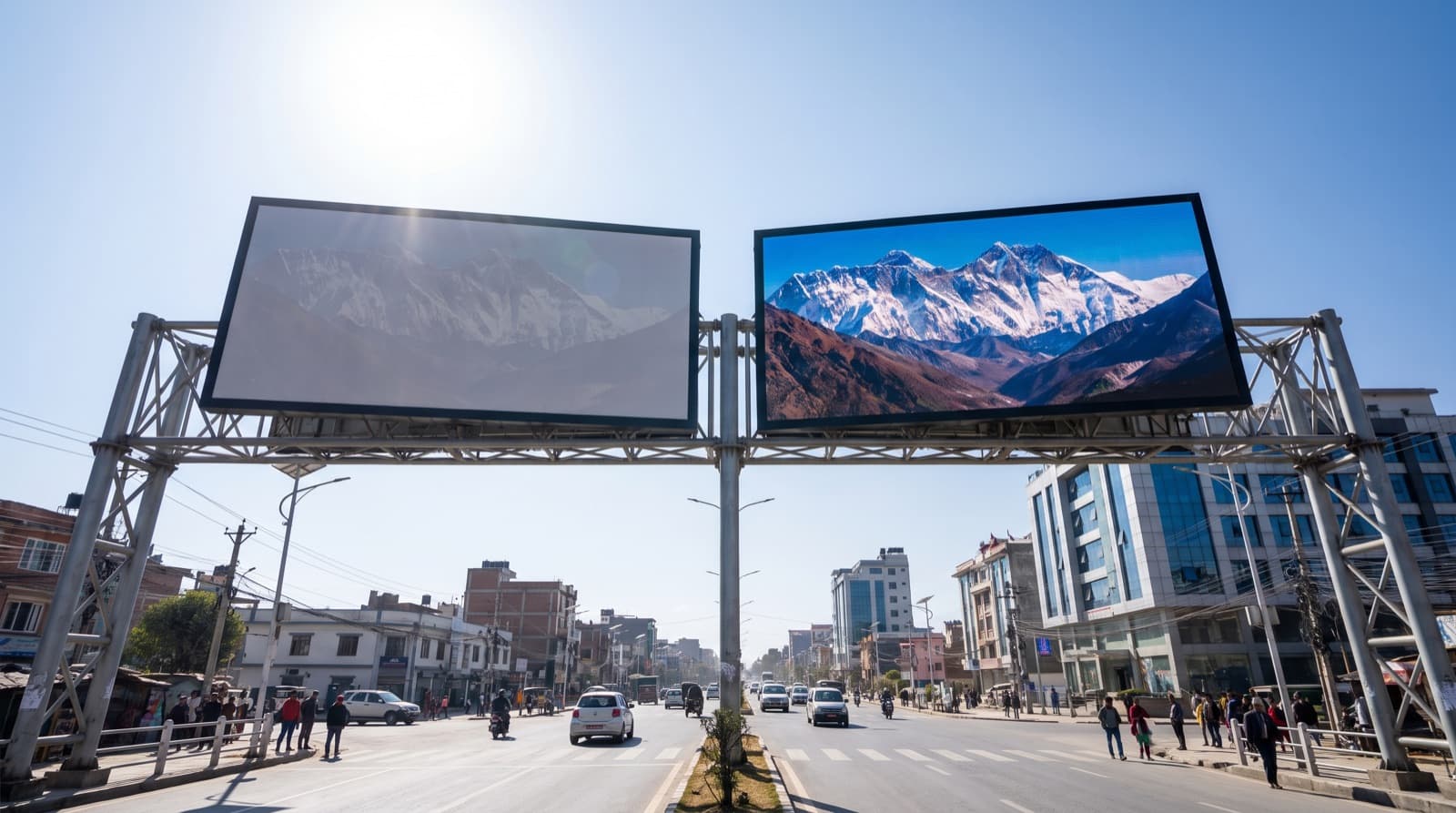
Grey by mid-morning means inventory you cannot sell.
Advertising value is concentrated in daylight, when traffic is heaviest — and daylight is when an underspecified screen fails. A display that looks impressive at the evening handover can be a milky grey rectangle by ten the next morning. You will have bought the site, the structure and the permissions for inventory you cannot sell.
Running cost that outgrows the revenue
Sites get modelled on revenue with no real figure for electricity.
A large outdoor screen at full brightness around the clock draws serious power, and at Nepali tariffs that becomes the dominant line in the operating budget. Sites are frequently modelled on media revenue with no realistic figure for electricity, and the economics only surface a year in.
Monsoon water and the joints it finds
What fails is the connectors, not the LEDs.
Driven rain does not fall on an outdoor screen so much as at it, from the side and upward off the road. Sealing rated only on the front face, or gaskets that have hardened in UV, will admit water at the cabinet joints. What fails is almost never the LEDs — it is corrosion at the connectors behind them.
Every content change becoming a site visit
Driving to each screen eats the margin the network was built for.
A screen that can only be updated by someone physically at the controller is a screen whose campaigns change late and cost labour every time. On a DOOH network, that overhead scales with the number of sites and quietly eats the margin the network was built for.
How we specify around it
The decisions that separate a display that still works in year three from one that merely looked good on the quote.
6,000–10,000 nits with ambient dimming
Legible at midday, considerably dimmer at night.
Enough brightness to stay saturated against midday sun, with a light sensor that continuously matches output to conditions. The screen is legible when it needs to be and considerably dimmer at night, which protects both the power bill and your relationship with everyone living opposite it.
Smart dimming and scheduled shutdown
Turns low running cost from luck into a plan.
Automatic dimming plus scheduled on/off through the cloud platform cuts consumption materially against running flat out. Because outdoor screens rarely display full white in practice, real-world draw sits well below the peak rating — and the schedule is what turns that from luck into a plan.
IP65 front and rear, built for monsoon
Water that gets in is drained back out.
Sealed on both faces with UV-stable gaskets and designed drainage paths, so water that gets to the cabinet leaves it again rather than sitting against a connector. Specified for a climate with a genuine monsoon, not for a temperate average.
Remote scheduling and monitoring
Operating the network becomes a desk job, not a driving job.
Campaigns are loaded, scheduled and verified from a browser, and the platform reports faults, temperature and brightness per site. On a network of screens this is what makes operation a desk job instead of a driving job.

What brightness actually buys you
Reference installations worldwide
OOH media network
Nepal
Roadside DOOH on scheduled on/off to trim cost.
Best value in Nepal
Lampro
sister brand to Unilumin · best value in Nepal · COB · DOOH · rental
View Lampro →Where it's used


How we scope and deliver it
Seven stages, all handled by our own team. Nothing is subcontracted, which is why we can commit to the timeline at the point of quoting.
- 01
Site assessment
We come to the site and measure it — viewing distances, ambient light, sightlines, wall or ground conditions, and where the power and data will run. Free, and it is what makes the rest of the quote real rather than estimated.
- 02
Structural design
Mounting is engineered alongside the display, not after it. Steel structures are fabricated to suit the site, which for outdoor work means wind loading and foundations as much as the screen itself.
- 03
Specification & quotation
Pitch, size, brightness and IP rating chosen for how the screen will actually be used, then quoted as a complete system — panels, processing, structure, cabling and commissioning — so nothing surfaces later as an extra.
- 04
Supply
Genuine Unilumin product with CE and RoHS certification and full manufacturer authorisation — the documentation set government tenders require, which we hold from previous work.
- 05
Installation
Our own technical team, never subcontracted. A standard indoor or outdoor install between 2×1.5 m and 4×2.5 m takes two to three days including the mounting structure; spans over 6 m or awkward mounting typically run five to seven.
- 06
Commissioning & CMS
Point-by-point calibration, brightness and scheduling configured for the site, and the content management system set up so your team can change what plays without calling anyone.
- 07
Training & support
We train your staff on the system before we leave, then back it with a two-year warranty and spare modules held in Kathmandu — so a fault is a visit, not an import.
FAQ
How bright does an outdoor billboard need to be?
6,000 nits is the working minimum for a screen facing daylight; 8,000–10,000 gives headroom for direct sun on the face and for west-facing sites in the afternoon. Auto-dimming should then bring it well down after dark.
What does it cost to run?
Consumption depends on size, brightness and content — screens display mostly mid-tones, so real draw sits well under the peak figure. Auto-dimming and scheduled overnight shutdown are the two settings that make the largest difference, and both should be configured at commissioning.
What pixel pitch for a roadside site?
Viewing distance decides it. A billboard read from thirty metres or more works well at P6–P10; a screen at a junction where traffic stops close to it justifies P4 or finer. Specifying finer than the distance requires is the most common way to overspend on an outdoor site.
How does it survive the monsoon?
IP65 on both faces, UV-stable sealing and proper drainage. Ask specifically whether the rating covers the rear as well as the front — front-only ratings are common and are not adequate for driven rain.
Who handles the structure and the permissions?
An outdoor screen is a structural and regulatory project as much as a display one — foundations, wind loading, electrical supply and local permissions all sit alongside the panels. We scope the display and the mounting together so the two are engineered as one system.
Can one operator manage several sites?
Yes. Cloud scheduling handles content, dayparting, power schedules and fault alerts across a whole network from one login, which is what makes a multi-site DOOH business practical to run.
Talk to an expert about outdoor dooh & billboards
Tell us the site and the size — we survey, spec and quote it.